
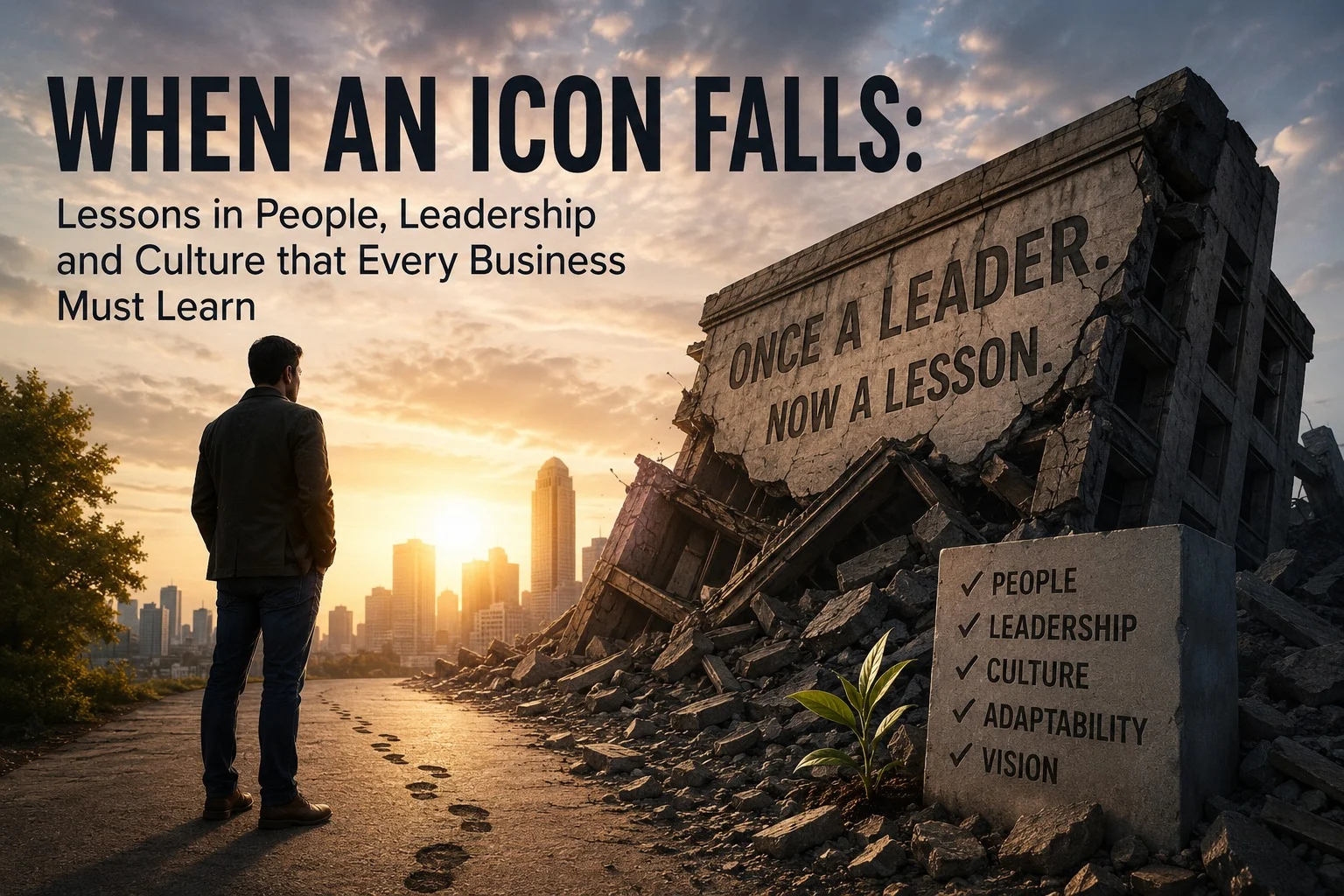
When an Icon Fell: The Company That Changed the Way I See HR
Recently, I read that the company where I spent nearly 14 years of my career had entered insolvency proceedings.
For most people, it was another corporate story.
For me, it felt like losing a part of my own history.
My father had spent his career there and retired with pride. Years later, I walked through the same factory gates as an employee. It wasn’t just a workplace—it was a legacy our family cherished.
Back then, it was one of India’s most respected engineering and automobile companies.
We believed it was too big to fail.
Years later, as an HR Consultant, I found myself asking a simple but uncomfortable question:
What really brings down a great company?
I no longer believe the decline begins with falling profits or market competition.
It begins much earlier.
- Small decisions that seem harmless at the time.
- Conversations that never happen.
- Knowledge that quietly walks out with retiring employees.
- Leaders who are never prepared.
- A culture that slowly stops learning.
Looking back, I realise that company taught me lessons far beyond my job.
- Success can become a blind spot. Markets reward relevance—not history.
- When experienced people leave without passing on their knowledge, organisations lose far more than employees.
- Leadership succession is not an HR activity—it’s a survival strategy.
- Trust between management and employees cannot be created during difficult negotiations. It has to be built every single day.
Most importantly, it changed the way I viewed HR.
Earlier, I believed HR existed to manage recruitment, payroll, compliance and policies.
Today, I believe HR exists to protect the future of the business by asking questions like:
- Are we developing tomorrow’s leaders?
- Are we preserving critical knowledge?
- Are we preparing people for changing business needs?
- Are we building a culture that embraces change?
The years also taught me that innovation cannot belong only to R&D.
Managers cannot think only about operations.
Every function must ultimately create value for the customer.
Because customers don’t care about internal politics.
They care only whether you solved their problem.
Finally, I learnt that great organisations are never built around exceptional individuals alone.
- They build systems.
- They develop people.
- They mentor future leaders.
- They create cultures that outlive generations.
Because buildings can be rebuilt.
Technology can be purchased.
Capital can be raised.
But culture…
Culture quietly shapes every decision—and eventually determines the destiny of the organisation.
Today, every HR framework, leadership model and governance system I develop carries these lessons.
Not because I learnt them in a classroom.
But because I witnessed a great institution rise, flourish… and eventually struggle.
So let me leave you with one question.
If your organisation disappeared ten years from now…
Would it be because of external competition?
Or because of the quiet decisions being made inside it today?
Sometimes, organisations don’t fail overnight.
They slowly drift away from relevance—one decision, one missed opportunity, and one neglected culture at a time.
If you are seeking strategic guidance to strengthen your organization or looking to enhance your professional growth, connect with Mr. Gajanan Y. Parab today to begin your journey toward measurable success and transformation.